The parting at Sakurai
Look at these statues. They are a father and his son.
It was an incredibly sad moment.
The father’s name is Kusunoki Masashige. He was a famous samurai, noted in Japanese history. He lived about 700 years ago, in the 14th century.
This is the place where he and his son said goodbye. They never saw each other again.
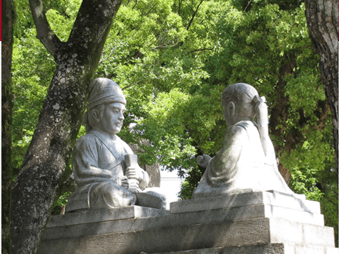
Masashige had to go to a big battle; the Minatogawa battle (1336). He knew the battle was hopeless, and he would probably die there.
His son, Masatsura, really wanted to follow his father into the battle. The boy chased after his father, and he pleaded to his father “Please let me come with you. I wanted to fight and die by your side.”
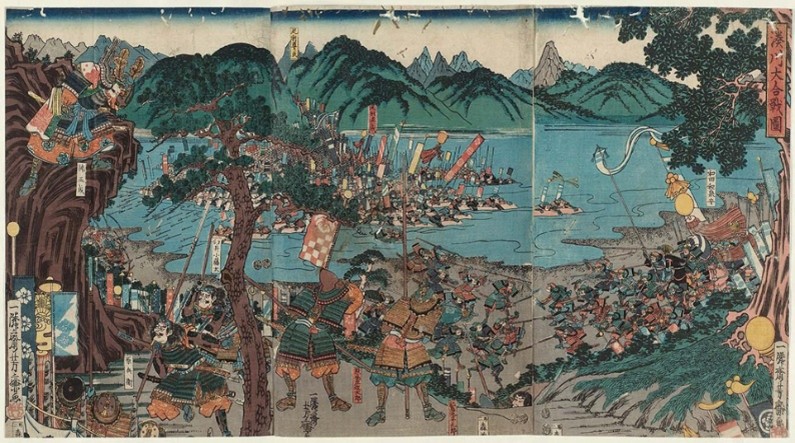
Masahige advised his son to go back to their hometown. It was not for his own reasons, but for their land. He gave his sword to his son as a special memory of this last goodbye.
Sadly, Masashige did die in the battle. When Masatsura heard that news, he wanted to die, too. But his mother stopped him and said, “You must live and follow your father’s wish.” The story is famous in Japan.
During that time, the traditional Japanese family system called “ie.” Ie means house. It started to take shape, especially among samurai families.
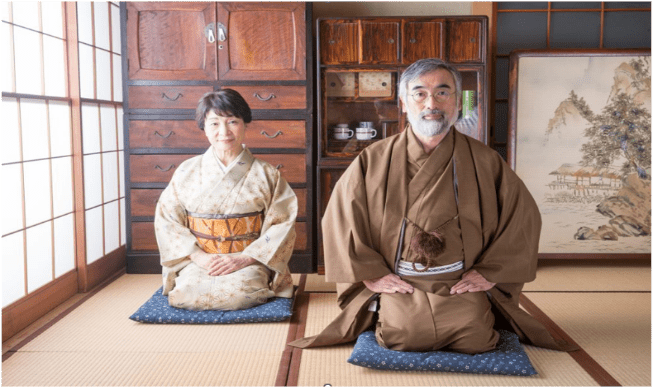
The “ie” was not just your father, mother and children. It was like a family corporation that must continue for many generations. The goal was to keep the family line, which was more important than any one person. The eldest son inherited almost everything; land, house, and power, to keep the family strong.
This system became much stricter in later Japanese history. But the roots were planted in the Kamakura (1185-1333) era.
This scene is remembered as a beautiful symbol of loyalty, sacrifice, and family love in Japanese history.
Note: this is part of the Shimamoto-cho Guide Text, created by the Yokoso Shimamoto (YS) English Guide Study Group; a text I helped revise. nakyu
Further note of general interest; I have attached more information.
Emperor Gotoba, used to have a palace in Shimamoto and come often; other Emperors also came.
I still have to visit the Museum, just across: this is the park.
The village of Sakurai, is famous for the emotional farewell between Kusunoki Masashige and his son Masatsura, is in modern-day Osaka Prefecture.
I take it he was on his way from Kyoto to Minatogawa, Kobe, where he lost the battle, and then committed seppuku. .
His story was later used to inspire soldiers, including kamikaze pilots, in World War II.
The specific site is preserved as the Historic Site Sakurai Station Remains Historic Site Park (史跡櫻井駅跡 史跡公園) .
Here is the key information for the location:
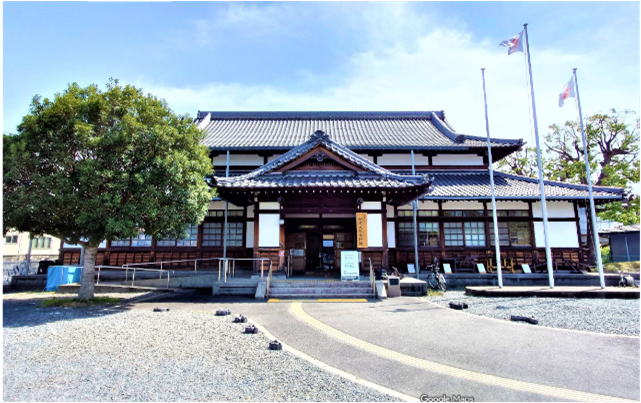
Location: 1 Chome Sakurai, Shimamoto Town, Mishima District, Osaka Prefecture 618-0022, Japan. Access: It is about a 1-minute walk from JR Shimamoto Station on the JR Kyoto Line .
Historical Context:
This site is traditionally identified as the location of a post station (Umaya) on the old Saigoku Highway.
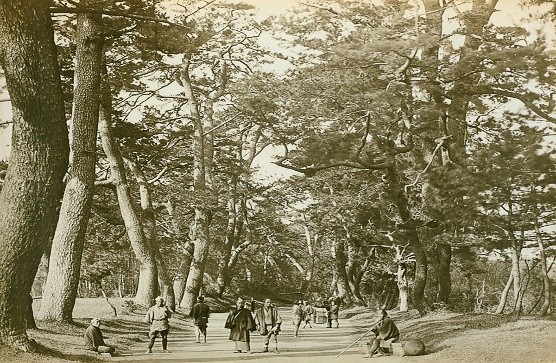
According to the Taiheiki, it was here in 1336 that Masashige gave his final instructions to his son Masatsura, sending him back to Kawachi while he marched to his death at the Battle of Minatogawa . This famous episode is known as the “Farewell at Sakurai” (桜井の別れ) and has been a popular subject in Japanese art for centuries .
Status: The park was designated a National Historic Site in 1921 and is open to the public free of charge .
In Shimamoto, remnants of this road still exist: the old Saigoku Highway.
Kusunoki Masashige is a famous historical person: here is the longer, more detailed version of his story.
Early Life and the “Emperor’s Dream”
Kusunoki Masashige was likely born in 1294 in Kawachi Province (modern-day Osaka Prefecture) . He was not from the highest ranks of the samurai class but rather a “well-to-do member of the rural gentry,” a scholar, and a devout Buddhist who received much of his early education at Kanshin-ji Temple .
His entry into history is shrouded in a famous legend. Emperor Go-Daigo, who was plotting to overthrow the Kamakura Shogunate, had a dream in which he was sheltering under a camphor tree. The Japanese word for camphor tree is Kusunoki. The emperor interpreted this as a sign that a warrior with that name would come to his aid . When Masashige appeared to offer his support, it seemed the dream had come true.
The Master of Guerrilla Warfare (The Genkō War, 1331-1333)
When Emperor Go-Daigo’s plot was exposed in 1331, sparking the Genkō War, Kusunoki Masashige raised an army in the emperor’s name . While the Emperor was quickly captured and exiled, Masashige and Prince Morinaga continued the fight.
He proved to be a military genius, unlike any other of his time.
Siege of Akasaka (1331): He held out against a vastly superior shogunate force using clever tactics, though the castle eventually fell .
Siege of Chihaya (1332): This was his masterpiece. From his nearly impregnable mountain fortress of Chihaya, he used guerrilla warfare—hit-and-run attacks, rolling boulders and logs, and nighttime raids—to tie down the entire main army of the shogunate for months . His successful defense demoralized the enemy and inspired other loyalists across Japan to rise up .
In 1333, the shogunate’s position collapsed. Key generals like Ashikaga Takauji turned their coats and attacked the shogunate, leading to its destruction . For his efforts, Masashige was rewarded by Emperor Go-Daigo with governorships and a high court rank .
The Kenmu Restoration and the Rise of Ashikaga
The Emperor’s new Kenmu Restoration government was short-lived. The powerful samurai felt their loyalty was not adequately rewarded, and the great general Ashikaga Takauji saw an opportunity to seize power for himself .
In 1335, Takauji rebelled against the Emperor . Masashige and another loyalist general, Nitta Yoshisada, were sent to stop him. At one point, they successfully drove Takauji from Kyoto and forced him to flee to Kyushu .
The Tragic Genius: The Battle of Minatogawa (1336)
In 1336, Ashikaga Takauji regrouped in Kyushu and marched on Kyoto with a massive, combined army and navy . Emperor Go-Daigo called upon his loyal commanders to defend the capital.
Kusunoki Masashige, the brilliant strategist, proposed a plan to avoid a direct confrontation. He suggested the Emperor take refuge on Mount Hiei, allow Takauji to enter Kyoto, and then, with the help of warrior monks, trap the Ashikaga army inside the city and crush them.
The Emperor refused. He insisted that Masashige and Nitta Yoshisada meet the enemy in open battle at Minatogawa (near modern-day Kobe).
Masashige knew it was a suicide mission. His smaller army would be crushed between Takauji’s main force and a second force landing by sea. However, in what would become the ultimate example of samurai loyalty, he obeyed his Emperor’s foolish command without question.
Before he left, he shared a famous farewell with his young son, Masatsura, at the village of Sakurai. He gave his son his death poem and instructed him to continue serving the Emperor . He then knowingly marched his army to its destruction.
At the Battle of Minatogawa on July 4, 1336, his prediction came true. As he engaged Ashikaga Takauji’s main force from the west, Ashikaga Tadayoshi landed behind him, attacking from the rear. Surrounded and with his army annihilated, Masashige performed seppuku (ritual suicide) with his brother, Masasue, and 60 of his closest clansmen .
Legacy: From “Traitor” to National God
His brother’s final words, according to the epic Taiheiki, were “Shichishō Hōkoku!” (“Would that I had seven lives to give for my country!”), to which Masashige agreed . This phrase, “Seven Lives for the Nation,” became immortal.
Initially branded a “rebel” by the victorious Ashikaga, his image was resurrected during the Edo period by scholars who made him a symbol of unwavering loyalty to the Emperor.
After the Meiji Restoration, he was deified. A shrine was built for him at the site of his death (Minatogawa Shrine in Kobe), and a famous bronze statue of him stands outside the Imperial Palace in Tokyo . His story was later used to inspire soldiers, including kamikaze pilots, in World War II .
Today, he remains one of Japan’s most revered historical figures, the “Prince of Chihaya,” and the ideal of the tragic, loyal samurai.
 Brave Spear English School
Leave a comment